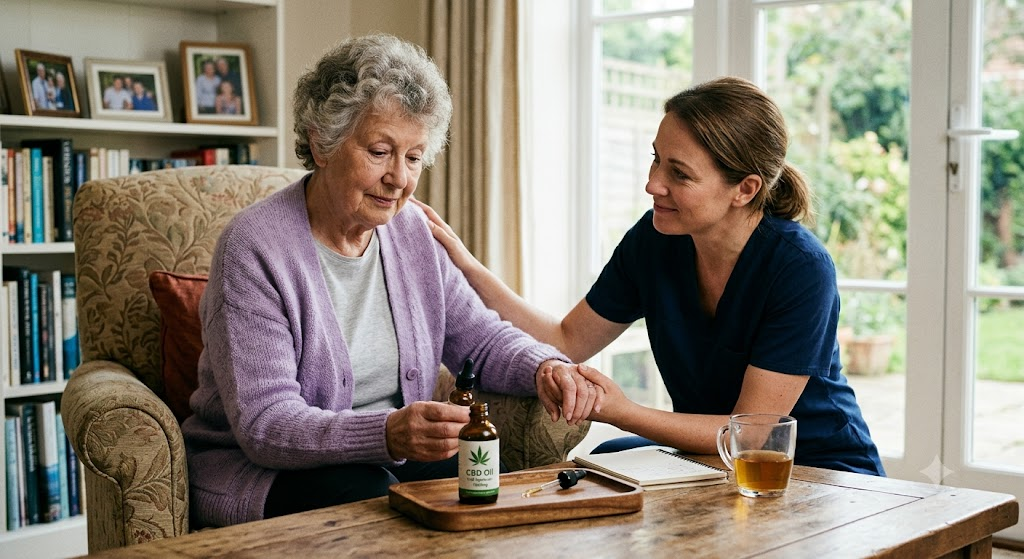
CBD for Dementia: What the Research Actually Says
Does CBD help dementia? Not on current evidence. The four trials in a 2021 Cochrane review tested THC or THC-like drugs, not CBD alone, and no study shows that CBD slows or reverses the disease. Dementia affects memory, mood and daily function, and many families ask about CBD; the research is still early.
Below, you’ll find what studies show, what caregivers are reporting, and what to consider before trying CBD or medical marijuana for a loved one with dementia.
Is CBD Good for Dementia? Here’s What the Research Shows
There is currently no evidence that CBD can stop, reverse, or prevent dementia, and a 2021 Cochrane review found no trial of CBD alone in dementia. Most current research is preclinical or in early clinical trial stages, and it focuses on managing specific symptoms rather than the disease itself.
A Phase 2 trial at the University of Colorado Anschutz Medical Campus, listed as recruiting in its June 2026 ClinicalTrials.gov update, is studying daily CBD use in adults at risk for Alzheimer’s disease, tracking cognitive function, sleep, and disease progression markers over the study period (clinicaltrials.gov, NCT05822362). Our post on cannabis and Alzheimer’s disease covers what the research shows about that condition. Separately, a 2026 review in Frontiers in Behavioral Neuroscience examined how cannabinoids interact with processes involved in Alzheimer’s disease, including inflammation and synaptic dysfunction, while noting that human clinical data still lags behind animal studies.
In short: researchers are actively studying CBD’s potential role in dementia care, but it is not an established or approved treatment.
How Might CBD Affect Dementia-Related Symptoms?
Some of the interest in CBD comes from its interaction with the body’s endocannabinoid system, which plays a role in regulating mood, sleep, and inflammation. Researchers believe this may be why some patients report changes in specific symptoms rather than the underlying disease progression.
A small 2023 retrospective study of 30 Alzheimer’s patients, with no control group, using a THC-dominant cannabis oil (22% THC, 0.5% CBD) for 12 weeks reported less agitation, irritability and sleep disturbance, and less caregiver distress (published in Clinica Terapeutica, indexed on PubMed). The study was small and did not include a control group, so it should be read as an early signal, not proof.
Symptoms most often discussed in current research and patient reports include:
- Agitation and irritability
- Sleep disruption, including sundowning, a common pattern of increased confusion in the evening
- Anxiety
- Appetite changes, common in later-stage dementia
The stronger research to date has tested THC or THC-like drugs, such as nabilone, rather than CBD alone, so results shouldn’t be attributed to CBD.
Marijuana for Dementia Patients: What Caregivers Are Reporting
Beyond clinical trials, caregiver research tells a similar story. One focus-group study of 26 caregivers of people with dementia found that 3 of the 26 were already giving cannabis to the person in their care, mainly for agitation and sleep problems, and that most of the others said they would consider giving it or using it themselves and wanted more guidance from clinicians. These are self-reported experiences, not clinical proof, and results vary widely by patient, dosage, and product type.
Caregivers considering this route for a loved one should talk with a physician familiar with the patient’s full medication list before starting anything, since the FDA warns that CBD can change how other medicines work and can add to the drowsiness caused by sedatives.
Medical Marijuana and Dementia Symptoms: What Small Studies Suggest
Based on current research and reported patient experiences, here’s what’s most commonly discussed:
- May help ease agitation in some patients, mainly in trials of THC or THC-like drugs, under physician guidance
- May reduce nighttime activity in some patients, based on small studies
- May help manage anxiety symptoms that often accompany dementia, though NIH finds only a small amount of evidence for anxiety
- May stimulate appetite in patients experiencing weight loss, an effect seen with THC rather than CBD
None of this means marijuana treats or slows dementia itself. These are potential symptom-management benefits reported in limited studies and patient experiences, not guaranteed outcomes.
Is Dementia a Qualifying Condition for Medical Marijuana in Florida?
Dementia and Alzheimer’s disease are not named on Florida’s official list of qualifying conditions. Florida law (section 381.986(2), Florida Statutes) lists cancer, epilepsy, glaucoma, HIV, AIDS, PTSD, ALS, Crohn’s disease, Parkinson’s disease, multiple sclerosis, a terminal condition diagnosed by a physician other than the one who certifies you, and chronic nonmalignant pain caused by, or originating from, a qualifying medical condition and lasting beyond its usual course. A qualified physician may also certify you for another condition if it is of the same kind or class as, or comparable to, one of the listed conditions other than a terminal condition or chronic nonmalignant pain; that decision is at the physician’s discretion, and certification is never promised.
That last category means a qualified physician may certify dementia only if it passes that same comparable-condition test; late-stage dementia can also qualify as a terminal condition (expected to cause death within a year) if a different physician diagnoses it. A patient whose dementia is of the same kind or class as, or comparable to, one of the first 10 listed conditions may still be evaluated case by case. Parkinson’s disease is itself on the list, so a patient with Parkinson’s disease and cognitive decline may be evaluated under that listed condition. This means a dementia diagnosis alone doesn’t guarantee certification. It depends on the patient’s full clinical picture and the certifying physician’s evaluation. Our post on medical marijuana for Parkinson’s disease covers what the research shows on that condition.
If you’re a caregiver in the Tampa, Fort Myers, or Sarasota area exploring this option for a family member, a sensible next step is a consultation with a physician who can review the patient’s specific symptoms and medical history.
What to Know Before Trying CBD or Medical Marijuana for a Loved One with Dementia
- Talk to a physician first. Cannabis products, including CBD, can increase or decrease the effects of other medicines, so a doctor should check every medicine a person with dementia already takes. If you want to understand how these interactions typically happen, this breakdown of CBD and drug interactions is a good starting point before you bring it up with a doctor.
- Get product form and dosage guidance from a doctor, not general online advice, since a review of dementia trials found sedation more common with nabilone than with placebo.
- Track behavior changes. If a physician approves a trial period, a simple log of sleep, mood, and agitation helps evaluate whether it’s actually helping.
- Understand this is symptom management, not treatment. Setting realistic expectations keeps focus on the patient’s comfort.
Caring for someone with dementia often means weighing options that don’t come with clear answers, and cannabis is no different. A useful next step is a conversation with a physician rather than research forums or anecdotal reports. A physician can look at the full picture: current medications, symptom severity, and whether a qualifying condition applies. That conversation, not a product choice, is the place to start for your loved one.
Frequently Asked Questions
Does CBD help with dementia?
Small studies, mostly of THC or THC-like drugs, were too few and too small for a 2021 Cochrane review to say whether cannabinoids help or harm people with dementia; a few report less agitation, and there is no evidence cannabis slows or treats the underlying disease.
Is CBD or THC better for dementia symptoms?
Most of the stronger research to date has studied THC or THC-like drugs such as nabilone, not CBD alone, particularly for agitation. This is a conversation to have with a certifying physician based on the patient’s needs.
Can a dementia patient get a medical marijuana card in Florida?
Dementia isn’t listed as a qualifying condition in Florida, so it qualifies only through the comparable-condition category or, in its late stages, as a terminal condition. Whether it qualifies is the certifying physician’s decision after an evaluation, and certification is never promised.
Last updated October 18, 2026 by the Dr. Green Relief Editorial Team.
Medical review
Medically reviewed by Achilles Kalnoky, M.D.
Reviewed on .
He is licensed in Florida as a medical doctor, license ME115088, which you can check on the Florida Department of Health license lookup.
His review covers the medical statements in this post and the sources cited for them.
Sources
- Bosnjak Kuharic D et al. Cannabinoids for the treatment of dementia. Cochrane Database Syst Rev. 2021 (PubMed)
- ClinicalTrials.gov. CBD for Individuals at Risk for Alzheimer’s Disease (NCT05822362), record updated June 15, 2026
- Komedera M et al. Cannabinoids in Alzheimer’s disease: animal-human evidence and clinical pharmacology challenges. Front Behav Neurosci. 2026 (PubMed)
- Palmieri B, Vadalà M. Oral THC: CBD cannabis extract in main symptoms of Alzheimer disease: agitation and weight loss. Clin Ter. 2023 (PubMed)
- Herrmann N et al. Randomized Placebo-Controlled Trial of Nabilone for Agitation in Alzheimer’s Disease. Am J Geriatr Psychiatry. 2019 (PubMed)
- Kaskie B et al. Cannabis Use among Persons with Dementia and Their Caregivers: Lighting up an Emerging Issue for Clinical Gerontologists. Clin Gerontol. 2021 (PubMed)
- FDA. What You Need to Know (And What We’re Working to Find Out) About Products Containing Cannabis or Cannabis-derived Compounds, Including CBD
- NCCIH. Cannabis (Marijuana) and Cannabinoids: What You Need To Know
- The 2026 Florida Statutes, s. 381.986, Medical use of marijuana (Florida Senate)