Full Spectrum vs Broad Spectrum CBD: What’s the Difference?
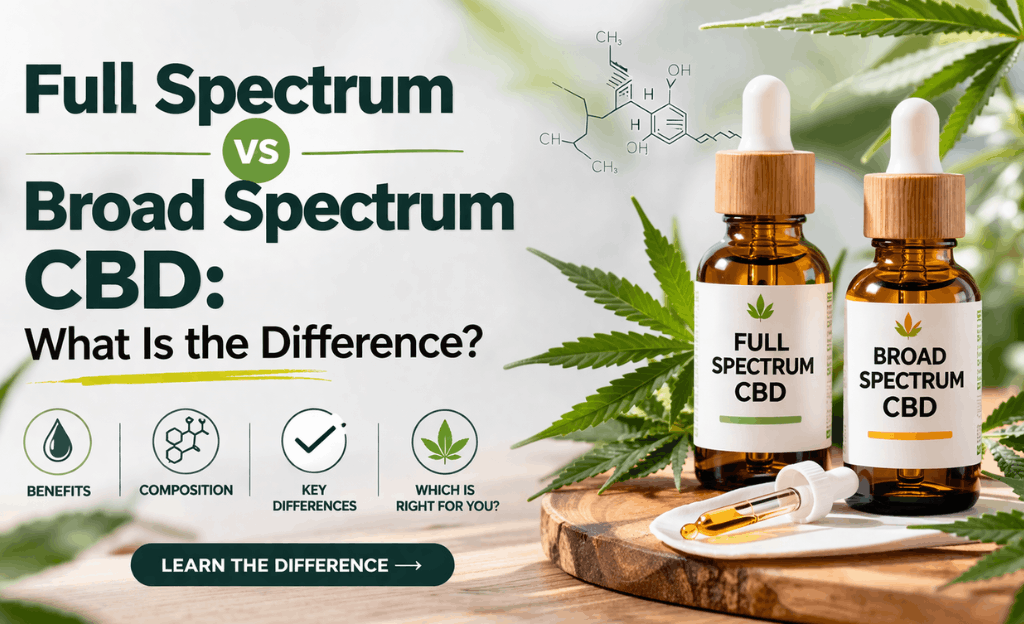
Full spectrum vs broad spectrum CBD comes down to one key difference: whether the product keeps the small amount of THC in the hemp extract. Full spectrum keeps it, while broad spectrum removes it. Drug test risk and, in one rat study, absorption follow from that difference.
If you have shopped for CBD products, you have probably seen both terms on labels with no clear explanation. NIH notes that over-the-counter CBD products may contain more or less CBD than the label states, so the label term alone tells you little.
This guide breaks down exactly what separates the two, what the research says about how each works, and how to decide which one fits your situation.
What Does “CBD Spectrum” Mean?
The word spectrum describes how much of the original plant profile survives extraction. Besides THC and CBD, more than 100 other cannabinoids have been identified in cannabis, along with terpenes and flavonoids. Manufacturers choose how many of these to keep.
- Full-spectrum CBD keeps most of the plant’s compounds, including a small amount of THC.
- Broad-spectrum CBD keeps almost everything except THC.
- CBD isolate is pure CBD with all other compounds removed.
Why does this matter? In a 2023 rat study, full spectrum CBD containing 0.2% THC was absorbed better than both CBD isolate and broad spectrum CBD. The study was in rats, not people.
What Is Full Spectrum CBD?
Full-Spectrum CBD is a hemp extract that keeps all the natural compounds from the plant. This includes CBD as the main cannabinoid, along with small amounts of THC, minor cannabinoids like CBG and CBN, plus terpenes and flavonoids.
Under the 2018 Farm Bill, hemp may contain up to 0.3% delta-9 THC by dry weight. From November 12, 2026, a 2025 federal law excludes from hemp products with cannabinoids the cannabis plant cannot produce naturally, and a 2026 law delays its 0.4 mg total THC per container limit until at least December 11, 2026, so check the lab report for total THC.
A pharmacokinetic study, published in the European Journal of Drug Metabolism and Pharmacokinetics, found that the presence of 0.2% THC increased the oral bioavailability of CBD in both male and female rats compared to CBD isolate, suggesting that full-spectrum products may produce greater systemic exposure than isolate formulations.
Some people prefer full spectrum CBD because of the idea of an “entourage effect,” a term coined in a 1998 study of the body’s own cannabinoid compounds. Whether plant terpenes and minor cannabinoids boost CBD in people has not been shown in clinical trials.
Hemp CBD products are sold without a prescription, so the choice usually rests with the buyer; a licensed physician can review interactions with your other medicines.
Who chooses it: people who accept trace THC, live where those products are legal, and do not face drug testing.
What Is Broad Spectrum CBD?
Broad spectrum CBD keeps other cannabinoids such as CBG and CBN, plus terpenes, but removes THC through an extra processing step. NIH notes that CBD products sold over the counter may still contain THC.
A 2018 review of observational studies in 670 people with hard-to-treat epilepsy found more reported improvement with CBD-rich extracts (71%) than purified CBD (46%), but no difference at the standard 50% seizure-reduction mark. It did not test hemp broad spectrum products.
In rats, broad spectrum CBD lacked the absorption boost that 0.2% THC gave. Whether that matters in people is unknown, so discuss it with a physician if you take other medicines.
Who chooses it: people who want to avoid THC, though products sold over the counter may still contain some, so drug-tested workers should read the lab report.
Full Spectrum vs Broad Spectrum CBD: Key Differences
The single defining difference is THC. Most of the other differences, including drug test risk and, in one rat study, how well CBD is absorbed, follow from that single factor. Here is a direct comparison:
Broad Spectrum and Full Spectrum CBD Compared
| Feature | Full Spectrum CBD | Broad Spectrum CBD |
| THC content | Up to 0.3% | None by design; traces possible |
| Entourage effect | Full: all compounds kept; any added benefit is unproven | Partial: no THC |
| Cannabinoids | CBD, CBG, CBN, THC + more | CBD, CBG, CBN + more |
| Terpenes | Yes | Yes |
| Drug test risk | Possible | Possible if traces remain |
| Typical buyer | Trace THC accepted | Avoiding THC |
| Extraction | CO2 or ethanol | CO2 + THC removal step |
One important nuance: broad spectrum is not always completely THC-free. “Non-detectable” means below that lab’s detection limit, and a 2018 study found labs report cannabinoid content differently.
Some drug tests may still flag trace amounts. If you face zero-tolerance testing, no CBD product sold over the counter can be counted on to be THC-free, isolate included.
Benefits of Full Spectrum vs Broad Spectrum CBD
Both types act on the endocannabinoid system, but clinical evidence for over-the-counter CBD products is limited, and NIH lists side effects such as sleepiness, diarrhea and liver injury.
Full spectrum benefits:
- Contains trace THC, up to 0.3% delta-9 THC by dry weight under the 2018 Farm Bill hemp definition, until the federal changes described above take effect
- Higher CBD absorption in rats (12% in males, 21% in females)
- Any pain benefit is unproven: NIH describes only a small benefit for cannabinoids in chronic pain
- Usually described as closer to the hemp plant’s natural profile; processing varies by maker
- May contain CBG, CBN, terpenes and flavonoids; only the lab report shows which and how much
Broad spectrum benefits:
- Keeps terpenes and minor cannabinoids but removes THC
- Avoids most THC effects, though CBD itself can cause decreased alertness and mood changes, NIH notes
- Lower THC exposure than full spectrum, though not always zero
- Still a drug test risk in regulated jobs, so read the lab report
- Absorbed less well than full spectrum CBD in a rat study
The practical gap between the two is unproven in people. A direct comparison in rats found full spectrum raised absorption compared with both broad spectrum and isolate. The NIH summary of cannabis research does not describe either type as a treatment for a health condition.
How to Choose Between Full Spectrum and Broad Spectrum CBD
The right choice comes down to four questions:
- Do you face drug testing? If yes, avoid full spectrum, and know that broad spectrum and isolate products can still contain THC; ask your employer’s testing program before you use any CBD.
- What are you trying to address? Evidence that CBD helps stress or sleep is limited, and no hemp CBD product is FDA-approved to treat pain. If you are considering medical cannabis for a qualifying condition in Florida, schedule a medical marijuana consultation with a licensed physician as the appropriate starting point.
- Are you sensitive to THC? Some people feel anxious or foggy from small amounts of THC. Broad spectrum lowers that risk, but lab reports are the only way to check what a product holds.
- Where do you live? Federal hemp rules start to change on November 12, 2026, and the limit of 0.4 mg of total THC per container is delayed until at least December 11, 2026. Florida requires hemp extract to have a lab certificate of analysis and bars selling ingestible or inhalable hemp extract to anyone under 21. Reviewing the legal medical cannabis rules in Florida will clarify what is permitted under the state’s medical marijuana program.
One other factor worth considering: testing matters as much as spectrum type. NIH notes CBD products can contain contaminants or more or less CBD than labeled, and Florida requires a certificate of analysis from an independent lab. Always look for third-party Certificate of Analysis documentation before purchasing any CBD product.
FAQs
What is better, broad spectrum or full spectrum CBD?
Neither is proven better for any health use. In one rat study, full spectrum raised CBD absorption compared with both broad spectrum and isolate. Broad spectrum lowers THC exposure, but no product sold over the counter is certain to be free of THC.
Is full spectrum CBD strong?
Full spectrum CBD raised CBD absorption in a rat study, but its strength in people depends on the dose and the product. Trace THC can add up with larger servings, and some people notice it. If you are exploring whether full spectrum cannabis products may support a qualifying medical condition, connect with a licensed marijuana doctor for an evaluation.
What are the three types of CBD?
The three types of CBD extract are full spectrum, broad spectrum, and CBD isolate.
- Full spectrum retains all plant compounds including trace THC.
- Broad spectrum removes THC while keeping most other cannabinoids and terpenes.
- CBD isolate is purified cannabidiol with the other plant compounds removed, though products sold over the counter can still contain traces of THC.
How to tell if CBD is full spectrum?
Check the product’s Certificate of Analysis (COA) from a third-party laboratory. A full spectrum product would usually show several cannabinoids, including THC at or below 0.3%, alongside terpene readings. If the COA shows only CBD, the product is likely an isolate. If THC reads as non-detectable but other cannabinoids are present, it is likely broad spectrum, though non-detectable only means below that lab’s limit. Products that do not provide a COA should be avoided regardless of what the label claims.
Last updated October 16, 2026 by the Dr. Green Relief Editorial Team.
Medical review
Medically reviewed by Achilles Kalnoky, M.D.
Reviewed on .
He is licensed in Florida as a medical doctor, license ME115088, which you can check on the Florida Department of Health license lookup.
His review covers the medical statements in this post and the sources cited for them.
Sources
- National Center for Complementary and Integrative Health, Cannabis (Marijuana) and Cannabinoids: What You Need To Know
- U.S. Food and Drug Administration, FDA Regulation of Cannabis and Cannabis-Derived Products, Including Cannabidiol (CBD)
- Public Law 119-37 (2025), Division B, section 781 (hemp definition)
- Public Law 119-103 (2026), Division B, section 2019 (section 781 extension)
- Florida Statutes s. 581.217 (2026), State hemp program
- Berthold EC et al. Comparative pharmacokinetics of commercially available cannabidiol isolate, broad-spectrum, and full-spectrum products. Eur J Drug Metab Pharmacokinet. 2023 (PubMed)
- Pamplona FA et al. Potential clinical benefits of CBD-rich cannabis extracts over purified CBD in treatment-resistant epilepsy: observational data meta-analysis. Front Neurol. 2018 (PubMed)
- Jikomes N, Zoorob M. The cannabinoid content of legal cannabis in Washington State varies systematically across testing facilities and popular consumer products. Sci Rep. 2018 (PubMed)
- Ben-Shabat S et al. An entourage effect: inactive endogenous fatty acid glycerol esters enhance 2-arachidonoyl-glycerol cannabinoid activity. Eur J Pharmacol. 1998 (PubMed)