Don’t Get a Marijuana DUI in Nevada
A marijuana DUI in Nevada is charged under NRS chapter 484C, the same law as an alcohol DUI, and a medical card is no defense. A first offense within 7 years brings 2 days to 6 months in jail or 48 to 96 hours of community service, a $400 to $1,000 fine and a 185-day license revocation.
The sections below set out the limits, the penalties and the statute behind each one. A first conviction within 7 years also brings an order to pay for and complete an educational course on alcohol or other substance use disorders.
A medical marijuana card will not get you out of a DUI charge. Under NRS 484C.110, being entitled to use marijuana under Nevada law is not a defense to a DUI. Nevada’s medical cannabis law also gives cardholders no exemption for driving under the influence of cannabis.
The tests and penalties below apply the same way to cardholders and everyone else.
This post is a summary for drivers, not a full statement of Nevada law.
We are not lawyers, and nothing here is legal advice. For that, talk with a Nevada lawyer.
What follows is our reading of NRS chapter 484C as checked on October 15, 2026, with the statute linked so you can read it yourself.
Marijuana and Driving: Quick Facts
- NIDA notes that cannabis can cause altered time perception and impaired thinking, memory and body movement. For a driver, that is a real risk.
- NIDA also reports that studies have found cannabis use may affect a person’s ability to drive.
- Studies suggest that the more marijuana you use, the more your driving can be impaired.
What Counts as a Marijuana DUI in Nevada?
- You drive while “under the influence” of marijuana, which means you’re incapable of safely driving your vehicle.
- For felony DUI charges only, a blood level at or above these numbers is enough on its own:
- 2 nanograms of THC per milliliter, or 5 nanograms of the metabolite 11-OH-THC per milliliter, in your blood.
- There is no urine limit for marijuana.
The problem with a blood number is that it doesn’t necessarily show whether you’re impaired.
People have different metabolism rates and tolerance levels. A blood number measures THC in your blood, not how you drive, and a low number does not mean you are safe to drive.
Nevada has since changed the law, so for a first or second DUI charged as a misdemeanor, a blood number alone does not prove the charge and the state must show you were under the influence.
How Do Police Test for a Marijuana DUI?
If an officer suspects marijuana use during a stop, the officer may look for signs such as these:
- You smell of marijuana
- Your pupils are dilated
- You have tremors
- Your short-term memory is impaired
- You seem unusually calm and relaxed
- You fail a sobriety test (standing on one leg, following a light with your eyes, walking in a straight line)
When alcohol is in issue, up to three blood or breath samples may be taken in the 5 hours after an arrest; for marijuana, the officer may request a blood test.
Nevada has an “implied consent” law. It means that the minute you get in your car and start driving, you are deemed to have consented to an evidentiary test of your blood, urine, breath or other bodily substance if a police officer has reasonable grounds to believe you were driving under the influence.
Penalties for a Marijuana DUI in Nevada
The penalties for a marijuana DUI in Nevada are set by the same section, NRS 484C.400, that sets them for an alcohol-related DUI.
First Offense (Misdemeanor)
- Jail Time: 2 days to 6 months
or
Community Service: 48 to 96 hours - Fine: $400 to $1,000
- Revoked License: 185 days; a restricted license may be available after half that time if you show severe hardship
- Educational course on alcohol or other substance use disorders, paid for by you
- Possible DUI Rehabilitation
- Required SR-22 Filing
Second Offense (misdemeanor, within 7 years)
- Jail Time: 20 days to 6 months
- Fine: $750 to $1,000
- Community Service: an equivalent number of hours may be ordered instead of the fine
- Revoked license: 1 year; a restricted license may be available after half that time if you show severe hardship
- 5-day suspension of the registration of each vehicle registered to you or owned by you, unless the court allows a family hardship exception
- Court-ordered treatment program
- Required SR-22 filing
Third Offense (if it occurs within 7 years of the previous offenses, it’s now a felony)
- State prison: 1 to 6 years
- Fine: $2,000 to $5,000
- Revoked license: 3 years
- 5-day suspension of the registration of each vehicle registered to you or owned by you, unless the court allows a family hardship exception
- Possible treatment program
- Required SR-22 filing
An SR-22, or Certificate of Financial Responsibility, is a certificate that your car insurance provider has to file with the state DMV. It proves you carry at least Nevada’s minimum liability insurance. After a DUI the DMV requires it for 3 years from the day your license is reinstated, and a lapse in coverage suspends your license again and restarts the 3 years.
Your insurance premiums may go up substantially. Your insurer sets the new rate, and in some cases, your insurance company may drop you altogether, leaving you without coverage.
What Happens If You Injure or Kill Someone in an Accident?
The penalties are far heavier.
- Jail Time: 2 to 20 years in prison if someone suffers substantial bodily harm, and 2 to 25 years if someone dies (5 to 25 years with one or two prior offenses)
- Fine: $2,000 to $5,000
- If you already have three or more DUI convictions on your record, you can be charged with vehicular homicide. That is a category A felony, punished by life in prison or a definite 25 years. Either way, parole eligibility starts after 10 years.
What If You’re Under the Influence of Marijuana, but the Accident Isn’t Your Fault?
The felony law asks for more than a blood test result.
As written, NRS 484C.430 makes it a felony when a driver who is impaired, or at or above the blood limit, does an act or neglects a duty imposed by law, and that act or neglect proximately causes another person’s death or substantial bodily harm.
Here is the kind of crash where that question comes up.
Let’s say you eat an edible at night and get into a car accident the following morning. It wasn’t your fault; the other driver hit you. You believe you were sober because you ate that edible the night before, but police still ask for a blood test.
Whether your own act or neglect proximately caused the harm in a crash like that is a legal question, so speak with a Nevada DUI lawyer.
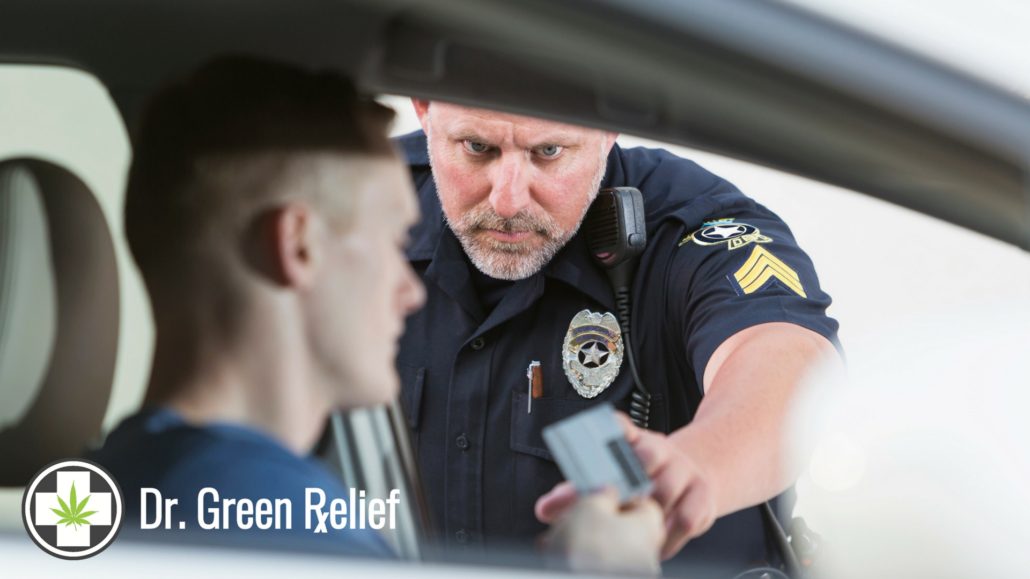
What to Do If Police Pull You Over
First of all, do not drive after using marijuana. Driving under the influence of marijuana is a crime in Nevada.
If police pull you over for any reason, these steps apply:
- Stay calm and pull the car over as soon and as safely as possible. Signal, and stop where the officer can safely walk up to your window.
- Make sure your insurance card, registration card and driver’s license are easily accessible ahead of time. That way, you’re not searching your glove compartment in a panic because you can’t find your documents.
- Roll your window down just enough to hear the officer and for him or her to hear you.
- Be polite and courteous.
- Keep your answers short and truthful. Ask to speak with a lawyer before you answer questions about what you have used or about your medical marijuana card.
- If the police officer asks for a blood test, don’t refuse. Refusing means your license will be revoked, and the officer may apply for a warrant or court order to draw blood using reasonable force. Refusing adds its own penalty.
- Call a lawyer if the police arrest you.
A marijuana DUI in Nevada carries serious penalties. You’re not just putting your own life at stake, but also the lives of the people around you.
Use marijuana responsibly, and do not drive after using it.
If you have any more questions about a marijuana DUI charge in Nevada, contact a lawyer.
Last updated October 15, 2026 by the Dr. Green Relief Editorial Team.
Sources
- Nevada Revised Statutes, chapter 484C, Driving Under the Influence of Alcohol or a Prohibited Substance (Nevada Legislature)
- Nevada Revised Statutes, chapter 483, Drivers’ Licenses; Driving Schools and Driving Instructors (Nevada Legislature)
- Nevada Revised Statutes, chapter 678C, Medical Use of Cannabis (Nevada Legislature)
- NIDA. Cannabis (Marijuana)
- Sewell RA, et al. The effect of cannabis compared with alcohol on driving. Am J Addict. 2009 (PMC)